Rebecca’s webpage

Welcome to my personal page! I’m Dr. Rebecca Shuhua Chen [she/her] and I’m a molecular and behavioural ecologist. On my website you’ll find information about my academic background and a summary of my past, current and future research projects.
About me
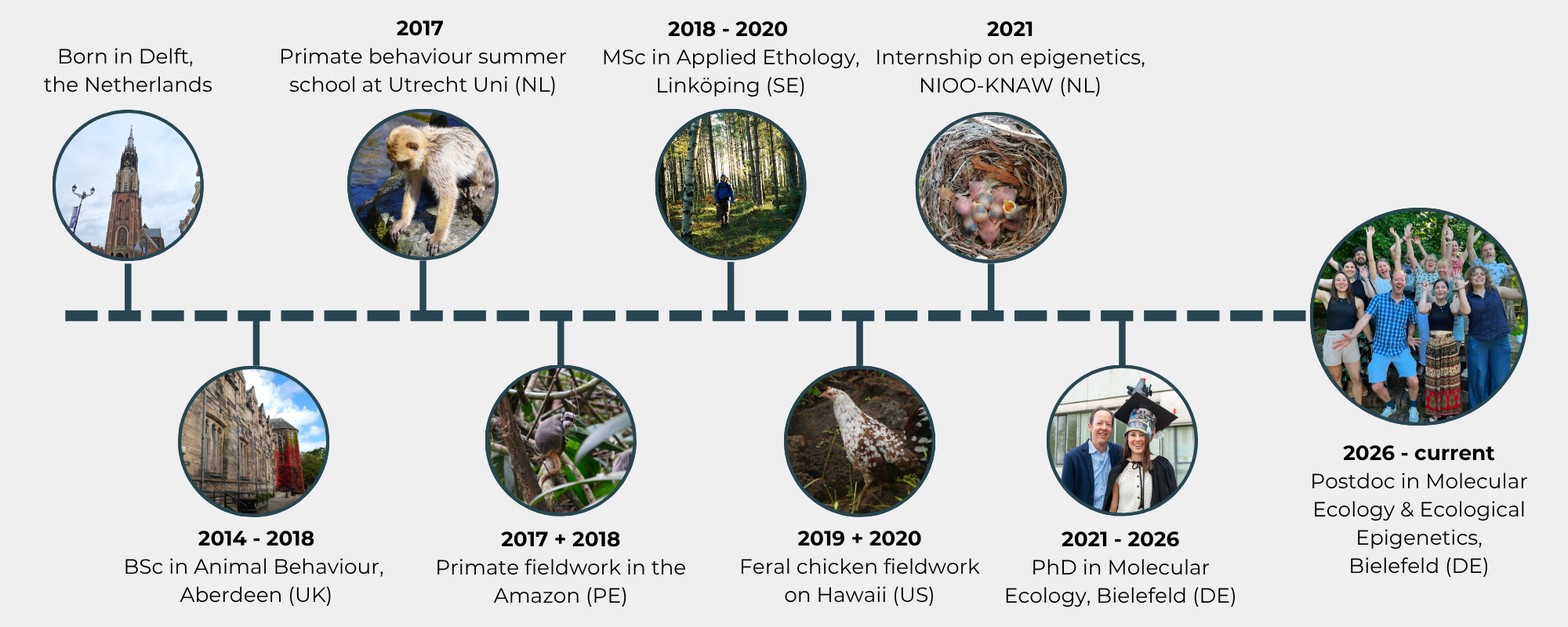
I am a postdoctoral researcher at the Hoffman Lab based at Bielefeld University, Germany. I completed my BSc degree in Animal Behaviour at Aberdeen University, Scotland, after which I continued with a MSc in Applied Ethology and Animal Biology at Linköping University, Sweden. While finishing my formal education, I developed a deep interest in molecular and evolutionary ecology. I obtained my PhD in evolutionary population genetics summa cum laude from Bielefeld University in May 2026, where I investigated mutation load dynamics in lekking black grouse.
I’m interested in understanding the proximate mechanisms shaping fitness variation using state-of-the-art genomic and epigenetic tools. A major part of my PhD utilised variant prioritization tools (GERP and SnpEff) to predict deleterious mutations and estimate individual genomic mutation load in male black grouse (Lyrurus tetrix).
Using a detailed dataset of black grouse phenotypic traits, including physiological, morphological, behavioural and fitness data, in combination with whole genomes, I explored how predicted deleterious mutations can help us understand the genetic architecture of fitness traits, inbreeding depression, purging and the honesty of sexual traits. My PhD project was co-supervised by Joseph Hoffman, Carl Soulsbury and Kees van Oers.
Current research
During my 2-year postdoc position in Bielefeld, I will continue exploring mutation load dynamics and ecological epigenetics, as well as their interactive effects. My current research projects focus on the following:
How does epigenetic ageing relate to reproductive effort in Antarctic fur seals? In this project, I am building an epigenetic clock based on male and female tissues samples, and relating epigenetic age acceleration to various fitness-relevant traits.
Is genomic mutation load related to female black grouse fitness? In this project, I adopt a similar approach as done in my PhD, but here we investigate how predicted deleterious mutations are related to brood size, egg mass and lifespan in females.
Can DNA methylation explain variation in black grouse ornamental traits? In my PhD, I did not find a relationship between deleterious mutations and ornamental expression. In this project, I investigate whether larger eyecombs, higher blue chroma and larger lyres are associated with differential epigenetic patterns.
Can epigenetic ageing predict life-history strategies in black grouse? Black grouse males might invest in reproduction at age 1-2 and die shortly after, or delay their age at first reproduction and live up to 6 years. In this project, I investigate whether live-fast-die-young strategies are related to epigenetic age acceleration utilising epiGBS2 to build a black grouse epigenetic clock.
How do deleterious mutations and DNA methylation interact to give rise to fitness variation? In my PhD, I wrote an opinion piece in which I hypothesize how epigenetic mechanisms might buffer and/or exacerbate the expression of deleterious mutations. In this project, I empirically test these hypotheses using the black grouse dataset.
Other interests
I have the privilege of working in a team where we regularly and openly discuss research practices and more importantly, how we can improve the way we do science. This stimulating environment has facilitated my interest in open science practices, addressing justice, equity, diversity and inclusivity issues in academia, and other ways of improving science.
When I’m not behind my desk you’ll find me upside down or hanging from a pull-up bar while practicing my calisthenics skills (body weight training), cooking (and eating), or I’m hanging out with my/a dog, enjoying the outdoors. As a biologist, I feel obligated to share my knowledge about climate change, animal welfare and biodiversity, and have therefore co-founded a sustainability platform to encourage sustainable living among the wider public.